Red Lion Gallery

paintings and drawings by
Guy Ottewell

Leo

home page
about

Other websites:

Universal Workshop
Xenophilia - in praise of minorities
The Lyme Maze Game


Site design and images
© Guy Ottewell 2007

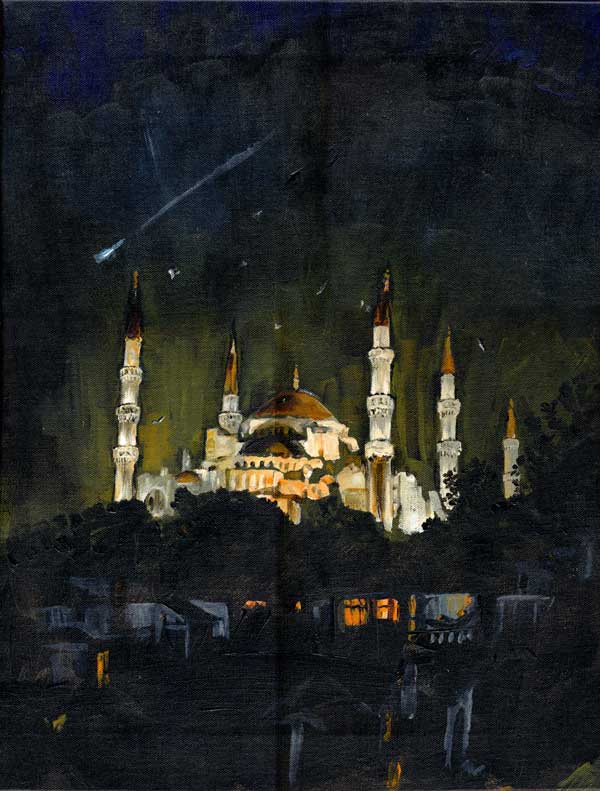
Sultan Ahmet mosque, Istanbul
We had watched the solar eclipse of August 11, 1999, from a village called Shenyurt near Turhal in eastern Turkey, and were on the way home. During a last and sleepless night in Istanbul I climbed stairs to a roof and got suddenly this eyeful. Gulls played in the light pouring upward over the domes and ledges and pinnacles, and a fireball of the Perseid meteor stream flashed over.

The mosque was built by architect Mimar Mehmet Aga for Ahmet I, who became sultan in 1603, not yet thirteen, and died at twenty-seven. It used to be called the Ahmediye, or the Blue Mosque, but now everyone seems to call it — and the jumble of little streets it dominates — just Sultan Ahmet, as if it were that fairly generous and pious and strong-willed young man himself.

A few days later, on August 17, a terrible earthquake shook all this part of Turkey. Concrete tenements collapsed, burying hundreds, but the slender minarets stood, as they had done for four centuries.

(This became the cover painting for Astronomical Calendar 2000.)

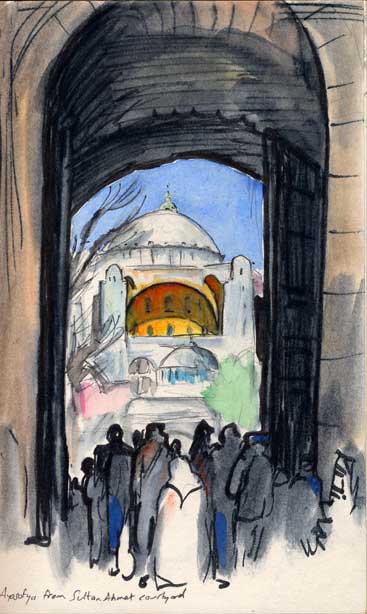
Hagia Sophia seen through the portal of Sultan Ahmet
Ayasofya seen through the portal of Sultan Ahmet
Hagia Sophia ("holy wisdom") was the basilica of Byzantium, and for a thousand years the largest church in the world. After the conquest by the Turks, they turned it into a mosque and modelled their own great mosques on it. I was standing in the crowd with my sketchbook.

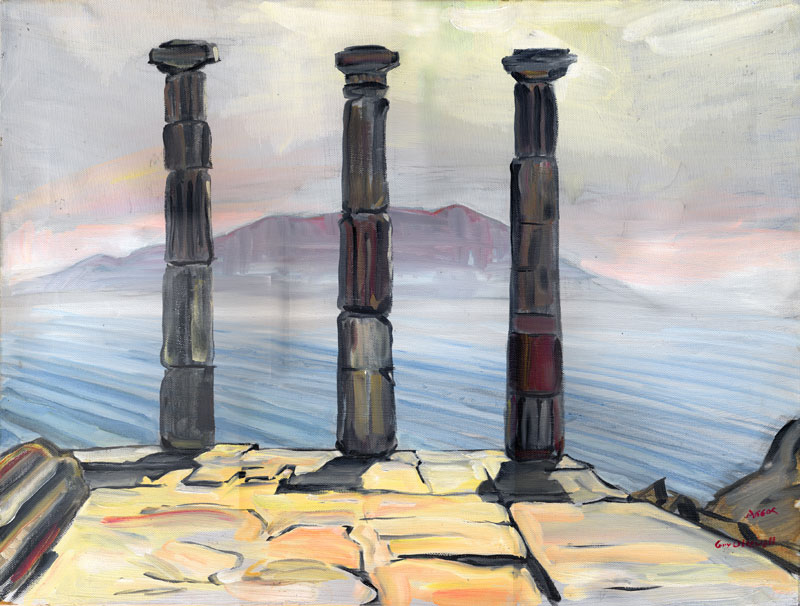
Assos
Assos
I explored the Troy-land by bicycle (not quite so adventurous as old geographers such as Walter Leaf who did it on horseback). After passing through thirty miles of interestingly twisted country south of Troy, I didn't get to the rugged corner, but crossed toward Assos, a place I wanted to see because of its curious situation. A river, the ancient Satnioeis, now called Yirmidere Çayi, "twenty-valley stream", almost gets through the hills (the westward arm of Mount Ida) to the sea on this southern coast, but turns back inland and takes another twenty miles to come out on the western coast. It was strategically obvious to found a place, Assos, on the narrow thread—which I imagined as a meadow—between river and sea. Walter Leaf, following Thacher Clarke, identified classical Assos (where Aristotle lived in exile) with Homer's "steep" Pedasos, stronghold of a race of Leleges allied to Troy.

It didn't appear as I expected: instead, as I came up what seemed to me yet another mountainside, something tall appeared on a skyline, and when I came to it I found it was Assos; so that I almost turned and went back down the road to understand again the approach I had missed. The tall something was these three pillars, re-erected presumably by archaeologists. They towered from the cleared pavement of the floor of the temple of Athena. Beyond them, dissolved in the southern sun, was the twelve-mile-wide gulf, combed by waves from the Aegean sea to the right, and the bulk of Lesbos, reduced to a flat purple wall. I made a large pencil drawing, noting some colors for painting.

Assos was now called by the Turks Behramkale (Persian plus Arabic, "Bahrâm's castle"). Though it did seem high above the sea, I had no idea that as soon as I went over the edge there would be such a long zigzag drop to the little port, the skala.

I found a way to make here the closing scene of The Troy Town Tale. The ruined temple reminds of the ruin that Achilles made of this place and its neighbors in his raid on Troy's friends.

And I used this painting as the wraparound book jacket. The three pillars echo the initials of the title, and the T-like pillars on the titlepage. The printer got the image too yellow; it looks muddy compared with the original.

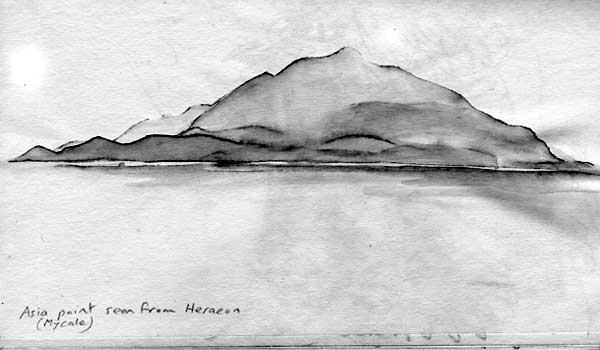
Mycale
Mycale
The headland now called Samsun Dag by the Turks. Sketched from a shrine of Hera while cycling around the Greek island of Samos, to which I had come by ferryboat from Kushadasi in Turkey.

The long mountain range, projecting into the sea as the promontory of Mycale, divided the ancient countries of Lydia and Caria. Later the Ionian Greeks colonized the coasts ro either side, and on the north (left) slope of the ridge was the Panionium, where their twelve cities met for a communal festival. At Mycale in August of 479 BC the Spartans and Athenians, having sailed over from Greece to rescue Samos, defeated the Persians on land and destroyed their beached navy; this, together with the battle of Plataea over in Greece on the same day, ended Persian rule over Ionia, as well as the second attempt of the Persians to conquer Greece.

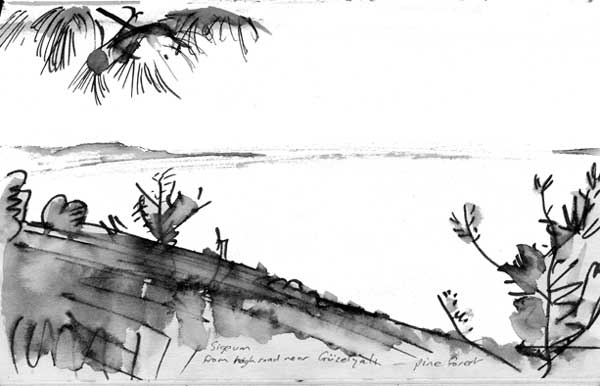
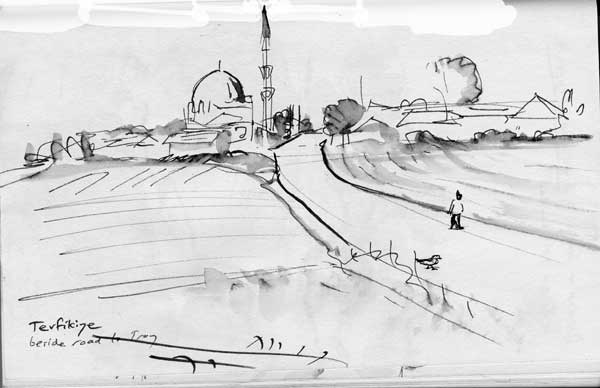
Some of my sketches on the way to Troy—
Guzelyali
Guzelyali
on the road along the Dardanelles coast; in the distance the Sigeum promontory beyond Troy.

Tevfikiye
Tevfikiye
village just before Troy.