| Other cover pictures: see the Turkey
page |

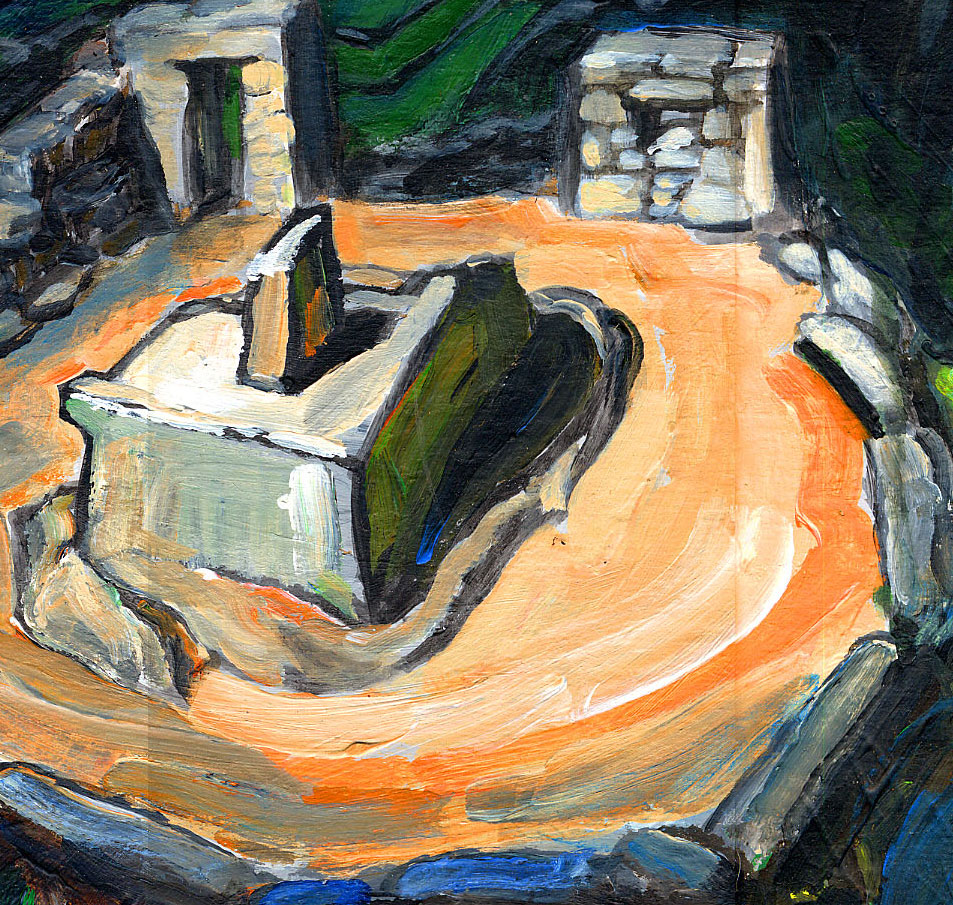
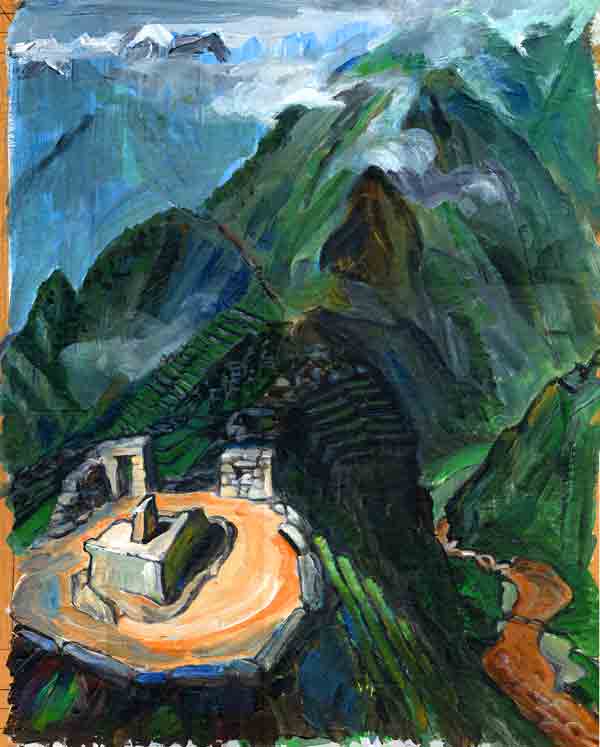
Machu Picchuthe Intihuatana or Hitching
Post of the Sun
At the June solstice, the Incas tied a ray around this stone, so
that Inti the Sun would not depart any farther north. The Urubamba
River is 2,000 feet below, and tourists arrive by the railway station
down there and then a bus up. I descended to Machu Picchu from 4,000
feet above, having walked for three days along the remains of an
Inca road of slabs among the peaks of the Andes and often above
the clouds. (Cover picture for Astronomical Calendar 1987,
after I had gone to see Halley's Comet from Bolivia and Peru.)

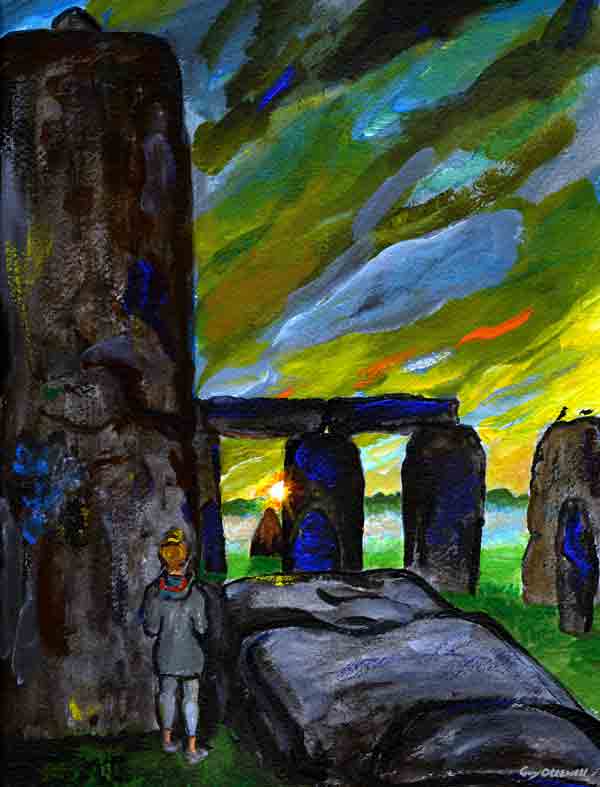
Midsummer sunrise at Stonehenge
We were allowed to be alone there for the 3:45 a.m. sunrise so that
I could paint this picture for my Astronomical Calendar 2003.
The towering stone on the left once formed the "grand trilithon"
with the fallen one to its right. The tenon on the great stone's
top, by which the lintel stone was connected, is Stonehenge's highest
point. Seen through this trilithon and perhaps across an altar,
the sun rises through an outer trilithon and above the distant Heel
Stone in the north-east.
Actually it was the day before the solstice, or we could not have
had it to ourselves. On midsummer morning itself, 22,000 people
were there. And sixty security persons, positioned to stop revellers
from damaging the stonesor hurting the chicks of the two pairs
of jackdaws that we saw nesting in the crevices.

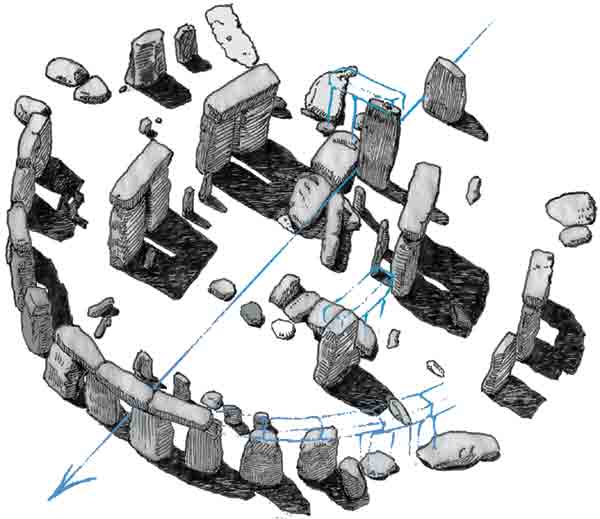
I included this diagram of the inner rings of Stonehenge. In the
book, unfortunately, a printer's error removed the gray. The blue
arrow is the northeastward axis
The same alignment, in the opposite direction, could have been used
to observe the midwinter solstice sunset, the farthest south.
Wouldn't this have had the same anxious importance that it had for
the Incas?

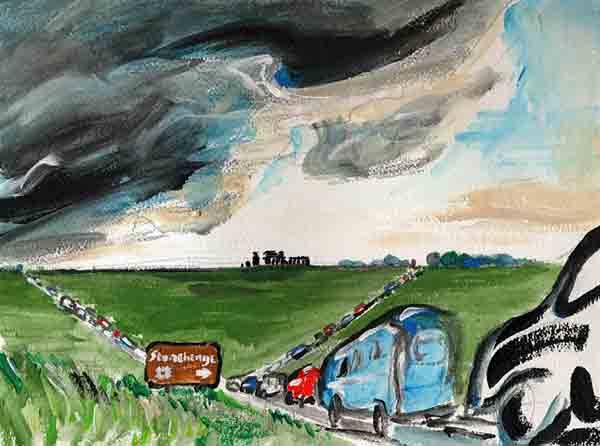
Also this impression of Stonehenge as we first beheld it on the
horizon, the evening before. (This had to be printed without color.)
We came riding along the bicycle-unfriendly highway that roars across
Salisbury Plain toward southwestern England. Terrifying highway
and looming cloud set an uneasy mood, but the following dawn was
fine and the slanting zone of cloud even enhanced the scene.

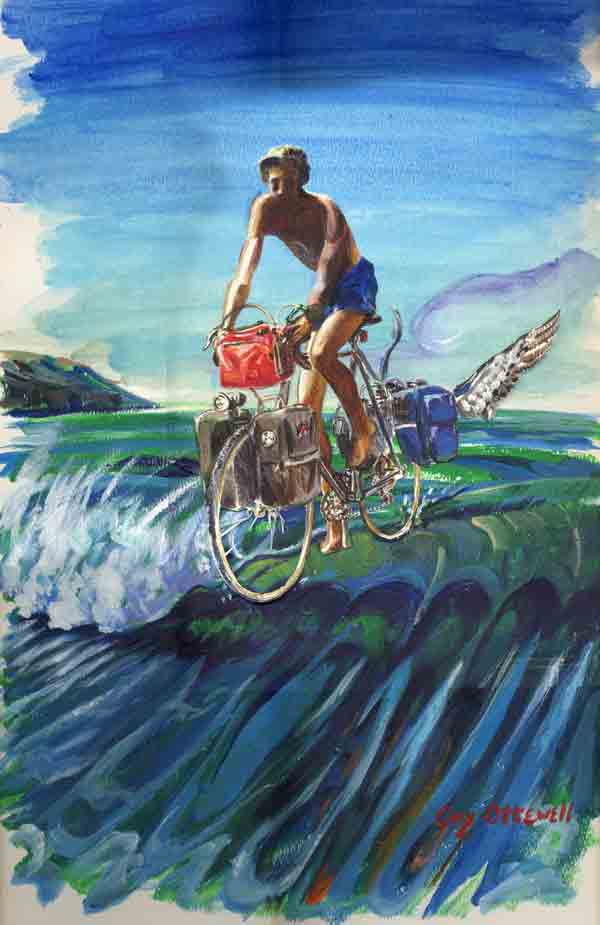
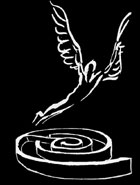
Winged Velocipede
Cover for my pamphlet about "how to ride overseas with your bicycle". The
pamphlet explains how to take the pedals off and how to mend flat
tiresthat sort of thingand forgets to mention how to
attach wings.

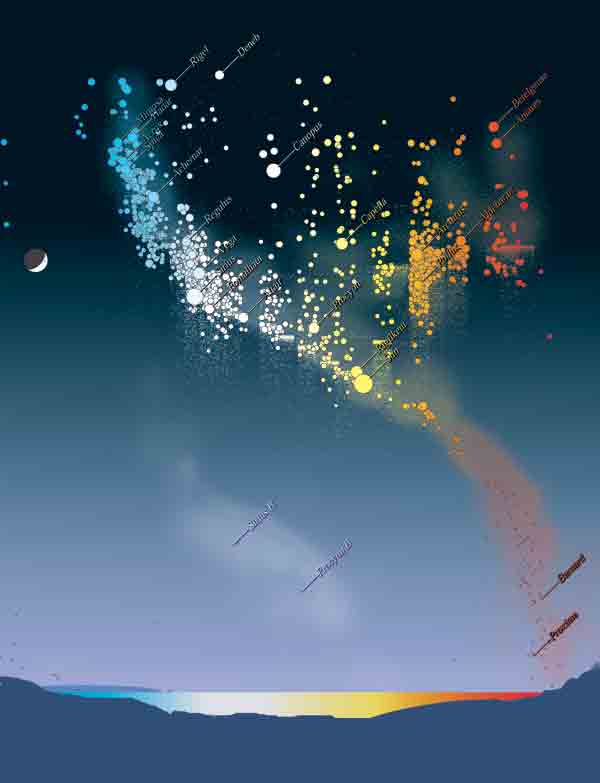
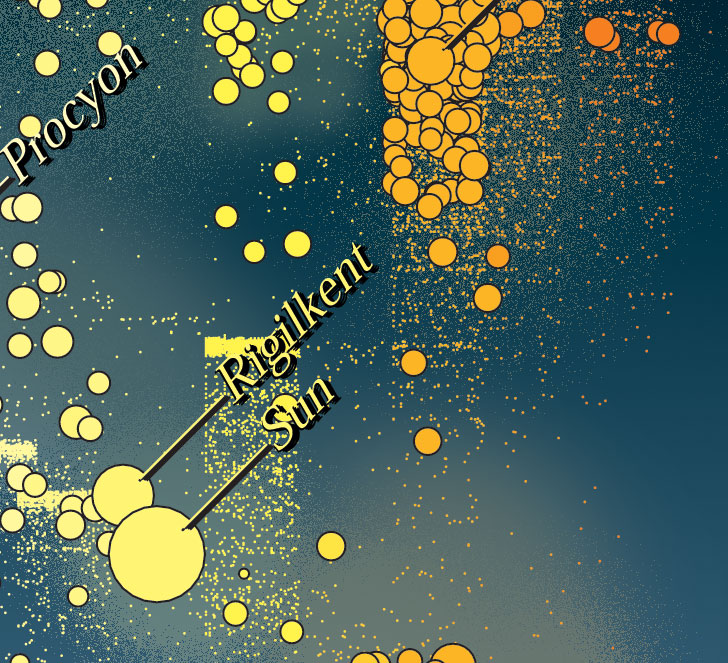
Hertzsprung-Russell aurora
Imagining all the stars in the galaxy rushing to place themselves
in your sky according to their luminosities and colorsthe
famous Hertzsprung-Russell graph, which tells scientists so much
about the nature and evolution of stars. Our sun is the yellowish
star half way down the "main sequence", looking bright
because all the giants are so far away. Cover picture for Astronomical
Calendar 2007, produced, I have to admit, not with paintbrush
but with Fortran and Photoshop.

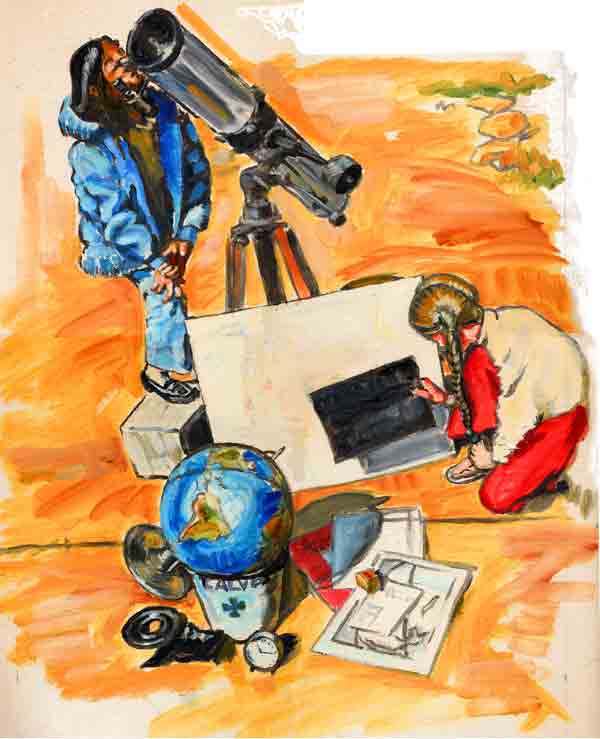
Watching an eclipse from Arizona
At Rough Rock in the Navajo reservation, Michele Pfeiffer (Navajo)
and Mary Lynn Blackburn (Anglo) using a telescope (with proper filter
across its aperture), a pinhole in black paper, and a globe-and-clothesline
model to observe the eclipse of March 7, 1970, whose track of totality
passed fifteen hundred miles away from them across the southeastern
U.S. (Cover picture for Astronomical Calendar 1984.)

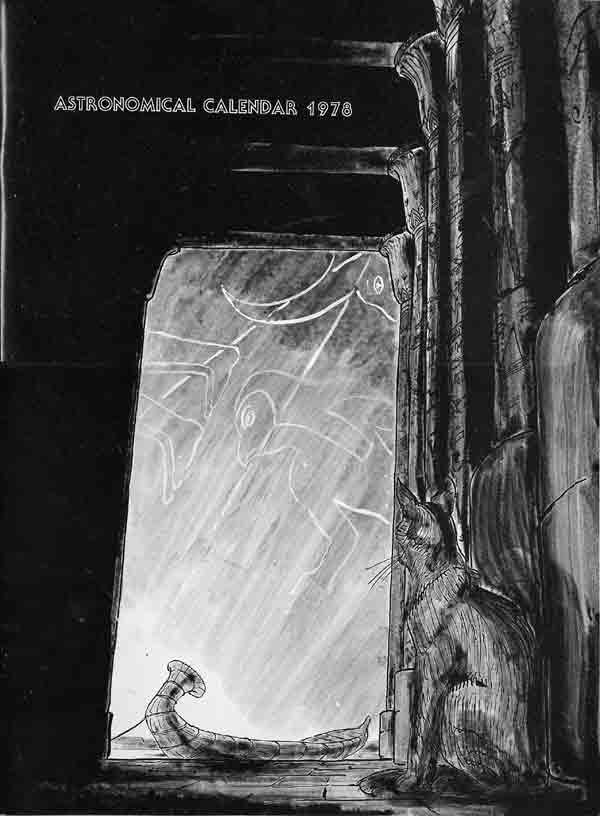
Sothis brings the flood
An Egyptian cat of 2500 B.C. watches the rising waters of the Nile,
the vital annual event which at that time was announced by the heliacal
rising (first visible rising before the sun) of Sirius, or Sothis,
the Dog Star. (Cover picture for Astronomical Calendar 1978.)

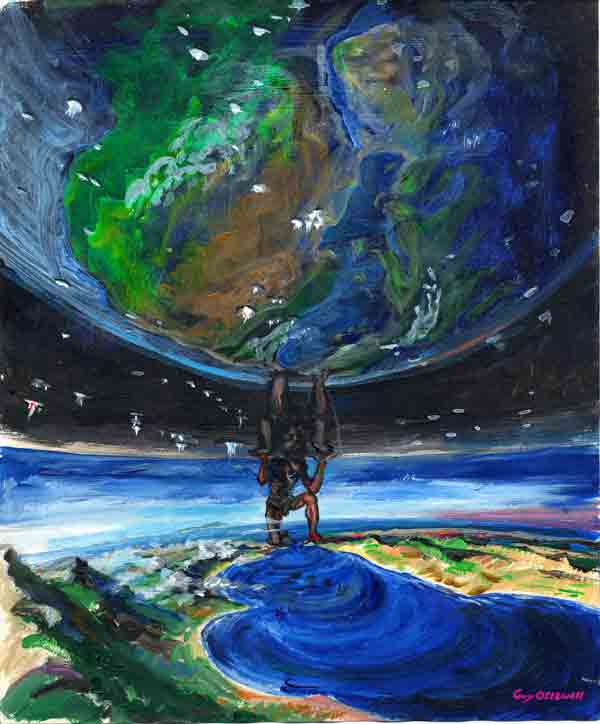
Atlas
Atlas, war leader of the Titans who fought against the gods, was
condemned to bear the sky on his shoulders for ever. He crouches
astride the Pillars of Hercules (the Strait of Gibraltar); he eventually
turned to stone as the Atlas Mountains of Morocco. Far in the Atlantic
Ocean behind him is a continent: not America but Atlantis. I imagine
him carrying a celestial globe (like the Roman sculpture called
the Farnese Atlas) in which the stars are pricked, and the earth
is mirrored (as in Mercator's picture of him carrying a terrestrial
globe, from which derives our word atlas). (Cover for Astronomical Calendar 1996.)

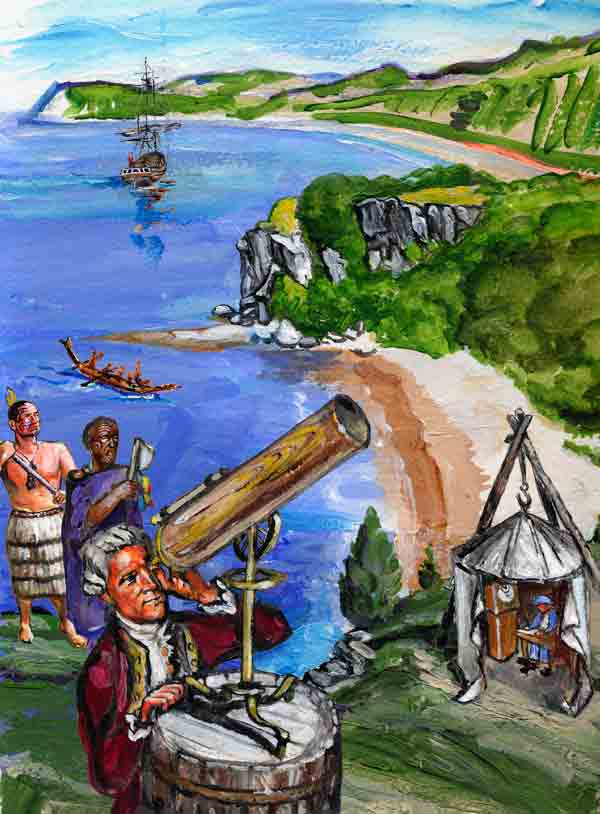
Cook and the transit of Mercury
I found myself at Mercury Bay in the Coromandel Peninsula of New
Zealand's North Island and learned that it was from here that Captain
James Cook had observed the transit of Mercury in November 1769.
So I realized I must do this picture for the Astronomical Calendar
for 2004, when there would be one of the rarer transits of Venus.
Cook had actually been sent on his Pacific voyage to observe the
same year's Venus transitthen considered of great scientific
importanceand he did that in June from Tahiti.

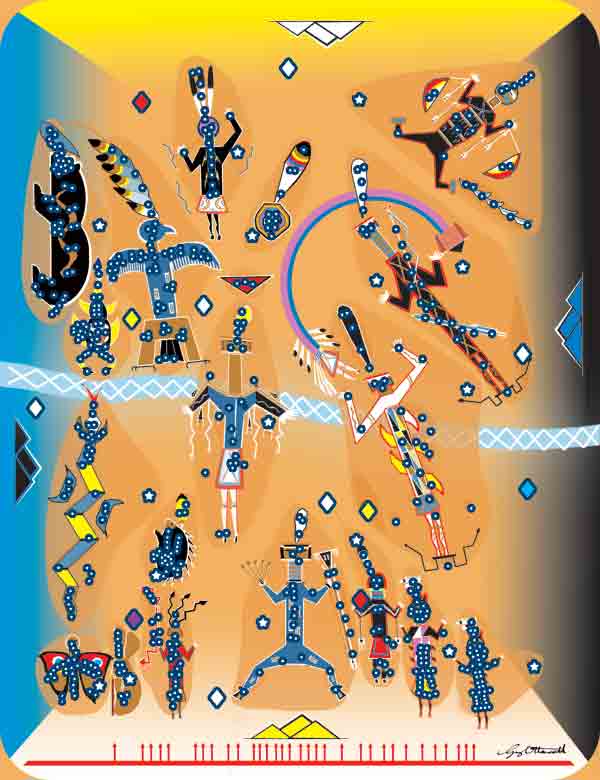
Navajo constellations
Ever since living in the Navajo reservation I had wanted to prepare
a more intelligible version of the map given in a little 1947 book
called Starlore Among the Navaho, by Father Berard Haile.
I finally did so for the cover of Astronomical Calendar 2006,
and tried to add the stylized figures and seven colors of Navajo
sandpainting.

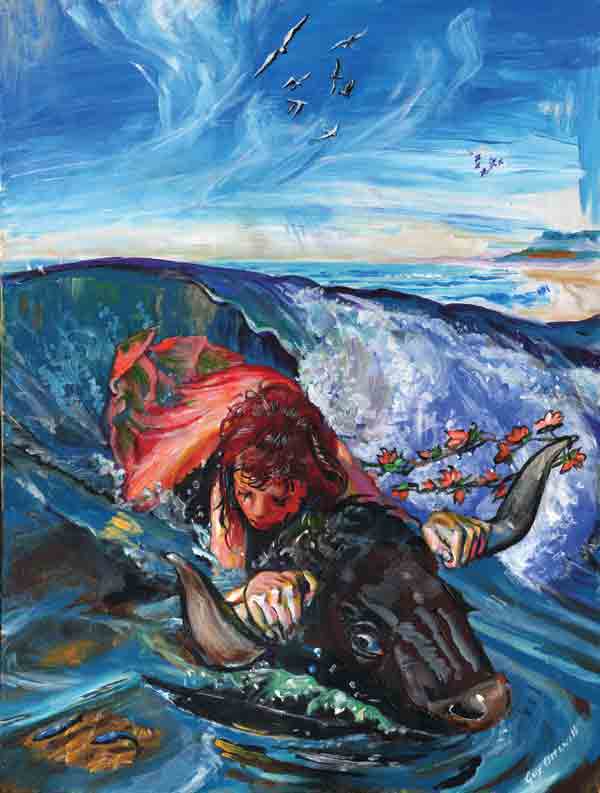
Europa and the Bull
Europa, princess of Phoenicia, was carried off across the sea by
Zeus in the form of a bull, to Crete, where she became the mother
of the Minoan civilization. Above Taurus the bull, the Hyades appear
as a disorderly swirl of gulls and the Pleiades as a tight flock
of doves. Cover picture for Astronomical Calendar 2005.

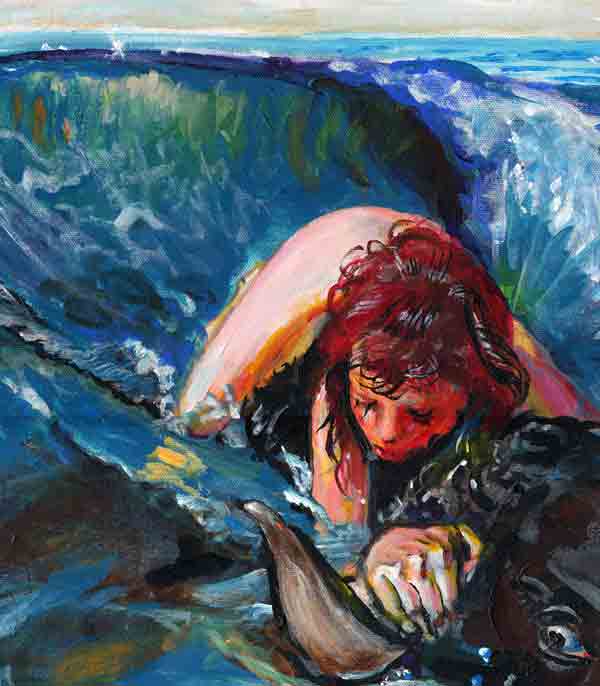
Europa nude
This was Europa before her robe of Tyrian purple was painted on
her.

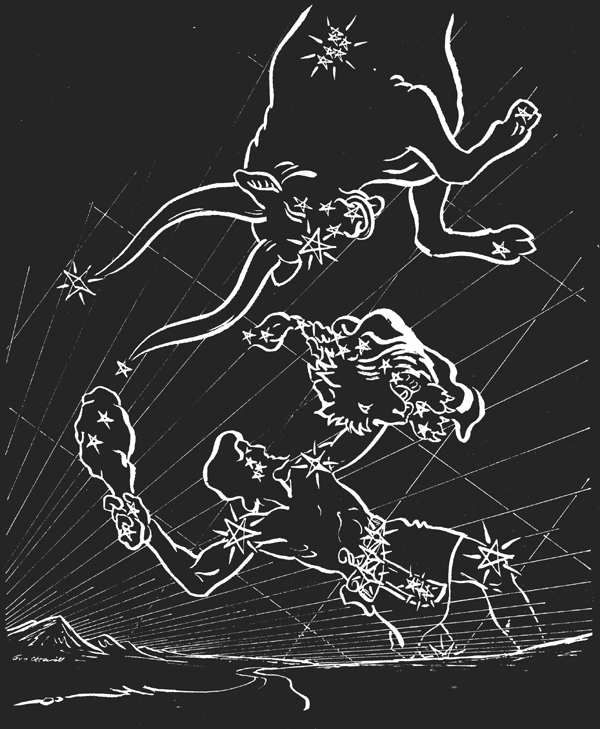
Orion rising
Cover for the first Astronomical Calendar (for 1974). Back then, it
was made by drawing black-on-white and having the printer "reverse"
it.

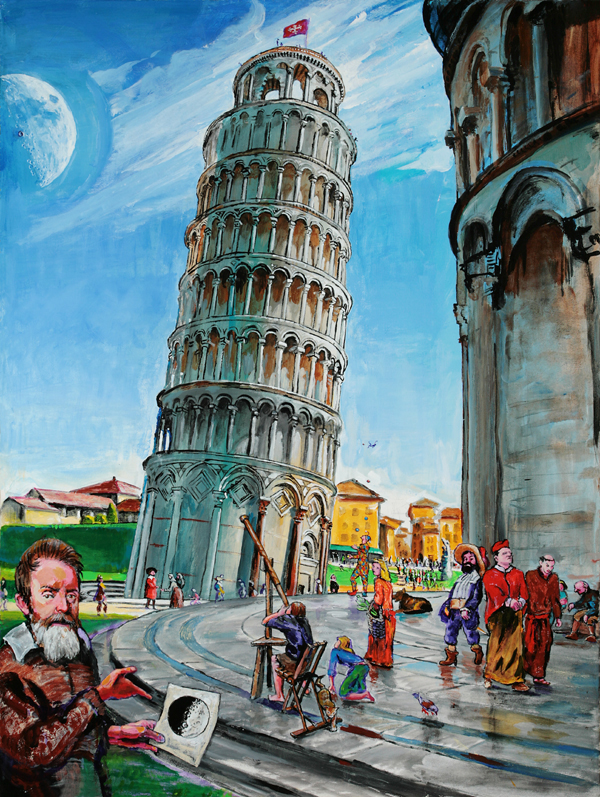
Pisa
with Galileo showing his telescope. Cover painting for Astronomical
Calendar2009. It was in 1609 that Galileo, having heard that
such a device had been invented in Holland the year before, started
making his own telescopes, which were good enough, when he turned
them on the night sky, to make amazing discoveries the mountainous
surface of the moon, thousands of previously unseen stars, the explanation
of the Milky Way as a multitude of stars, and then (in 1610) the
satellites of Jupiter and the phases of Venus. These discoveries,
along with Kepler's explanation also in 1609 of the motion of the
planets, launched the modern age of astronomy, which is why we celebrated
them in International Year of Astronomy 2009.
Galileo was a professor in Padua and later in Florence, but I
imagined him revisiting his birthplace, Pisa. It was there that
(according to story) he dropped bodies of different weights from
the Leaning Tower to show that they fall at the same speed, and
noticed that a lamp hanging in the cathedral swung to the same period
whether swinging a long way or a short the law of pendulums,
which he foresaw could be used in clocks.
Pisa's famous or notorious Leaning Tower is the bell-tower or campanile
for the Duomo or cathedral. The most photographed view of
the two buildings is from a gateway over to the left, but I liked
this closer viewpoint because the semicircular platform around the
cathedral's apsidal east end adds a sweeping elliptical shape to
the verticals (or near-verticals) of cathedral and tower. And in
the southeastern sky to the left of the tower I could position the
first-quarter moon (enlarging it surrealistically to suggest the
view in the telescope). A minor challenge was that the tower is
actually vertical as seen from here, because it leans south, so
I gave it a twist to the west. A slightly greater challenge was
that the weather was thin-cloudy, the contrast of sun and shadow
not strong; I had to sharpen it. And the greatest challenge was
that, if it was to be daytime, and the moon in that part of the
sky, it would have to be afternoon, with the sun away to the right,
hence the whole foreground in the cathedral's shadow. I thought
that could be interesting, a purplish foreground, with figures silhouetted
against the stream of golden sunlight going past in the middle distance,
their faces without the benefit of the contrast of light and shadow,
but I thought I could do it. Making details distinct when they're
dark on dark is difficult, and I only partly succeeded. It looks
better on the book than it does here.
The cathedral precinct (called the Piazza dei Miracoli) teems with
people, though in costumes sadly less paintable than they would
have been wearing in the seventeenth century. The disdainful cardinal
and friar, representing the churchmen who put Galileo on trial for
upsetting two thousand years of dogma, are unkind versions of Italian
gentlemen I sketched as they walked by right here the "cardinal"
with uplifted eyes could have been composing a poem, and the "friar"
had not a tonsured head but a mop of curly hair. The sea captain,
interested in Galileo's telescope because it could reveal ships
two hours' sail away, will be recognized by readers of the Tintin
books as Sir Francis Haddock in "The Secret of The Unicorn".
|