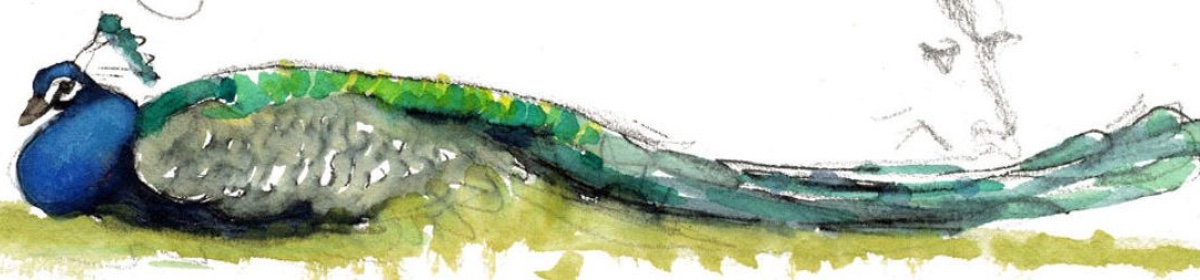
If information, such as photons of light, falls into a black hole, it can’t get back out. It’s lost to the world.
Unless some of it slips back out by a dodge called Hawking radiation.
On these mysteries there are paragraphs in the Astronomical Companion and in Albedo to Zodiac, which I’m also revising toward a new edition.
The radiation, proposed by Stephen Hawking as a consequence of quantum theory, is a kind of cosmic smuggling, a crossing of borders and eluding of checkpoints.
When, in the ordeal of downsizing, I throw out books, pictures, files of papers, they are doomed to the black hole of the landfill. Except:
The many books and few other items that won’t be lost to the world, only to me, continuing in existence elsewhere because someone else will take them, or has copies of them.
A few can quasi-survive, like the virtual particle that escapes the black hole: kept in digital form, ghosts of themselves, by another sort of electromagnetic dodge. I can put each on the scanning machine; or, if too large, lay it on the floor and make a crude photo.
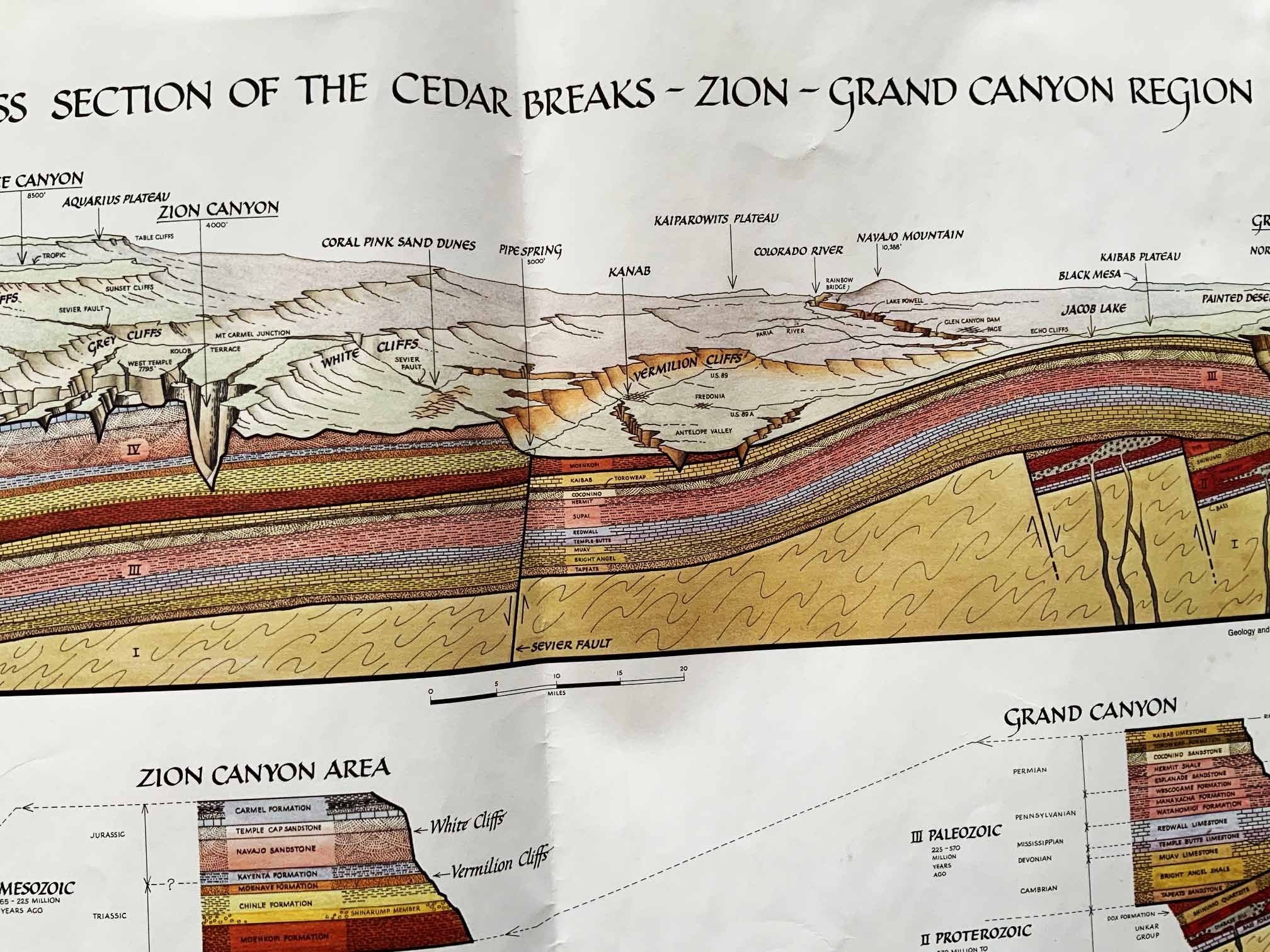
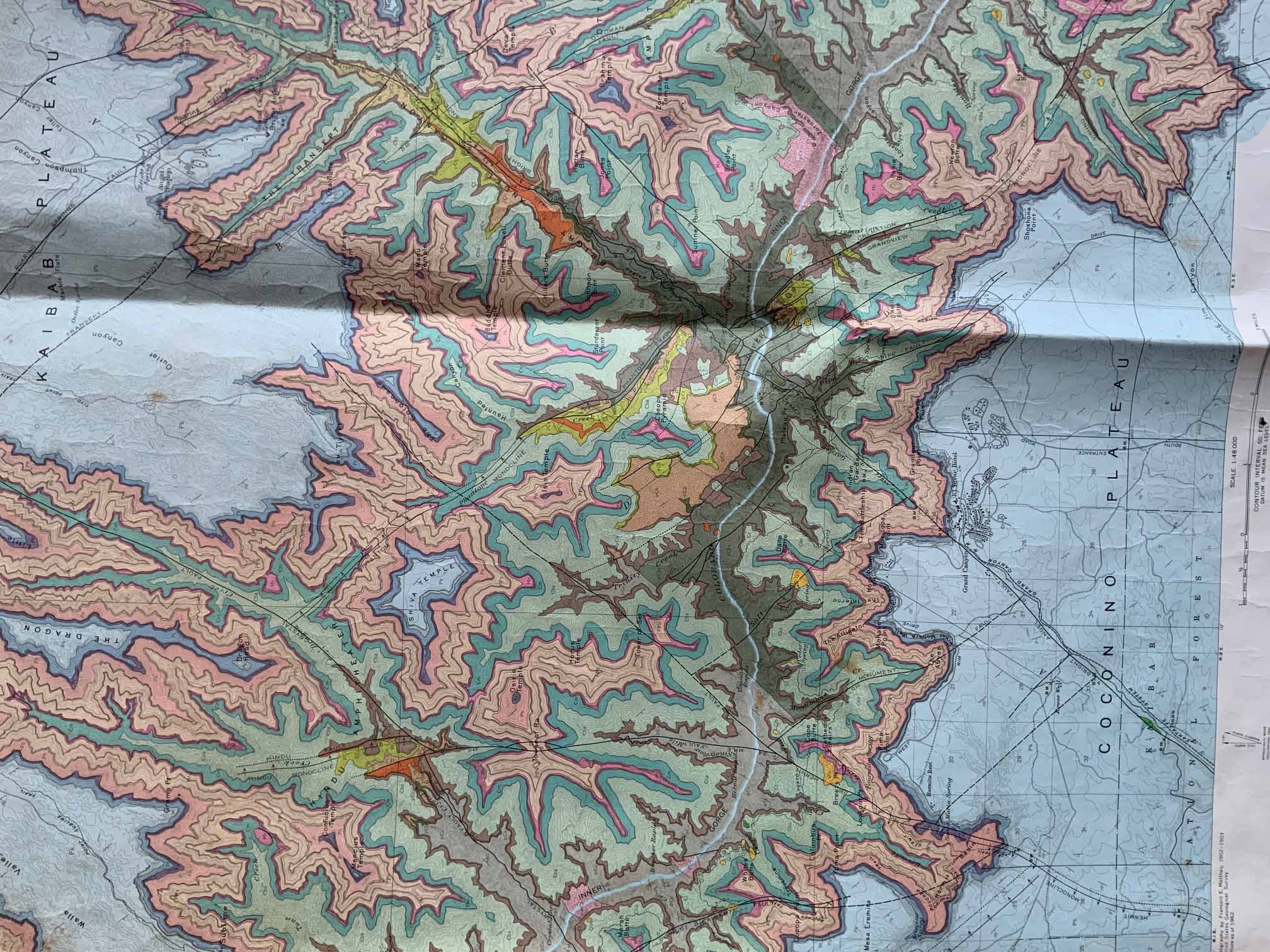
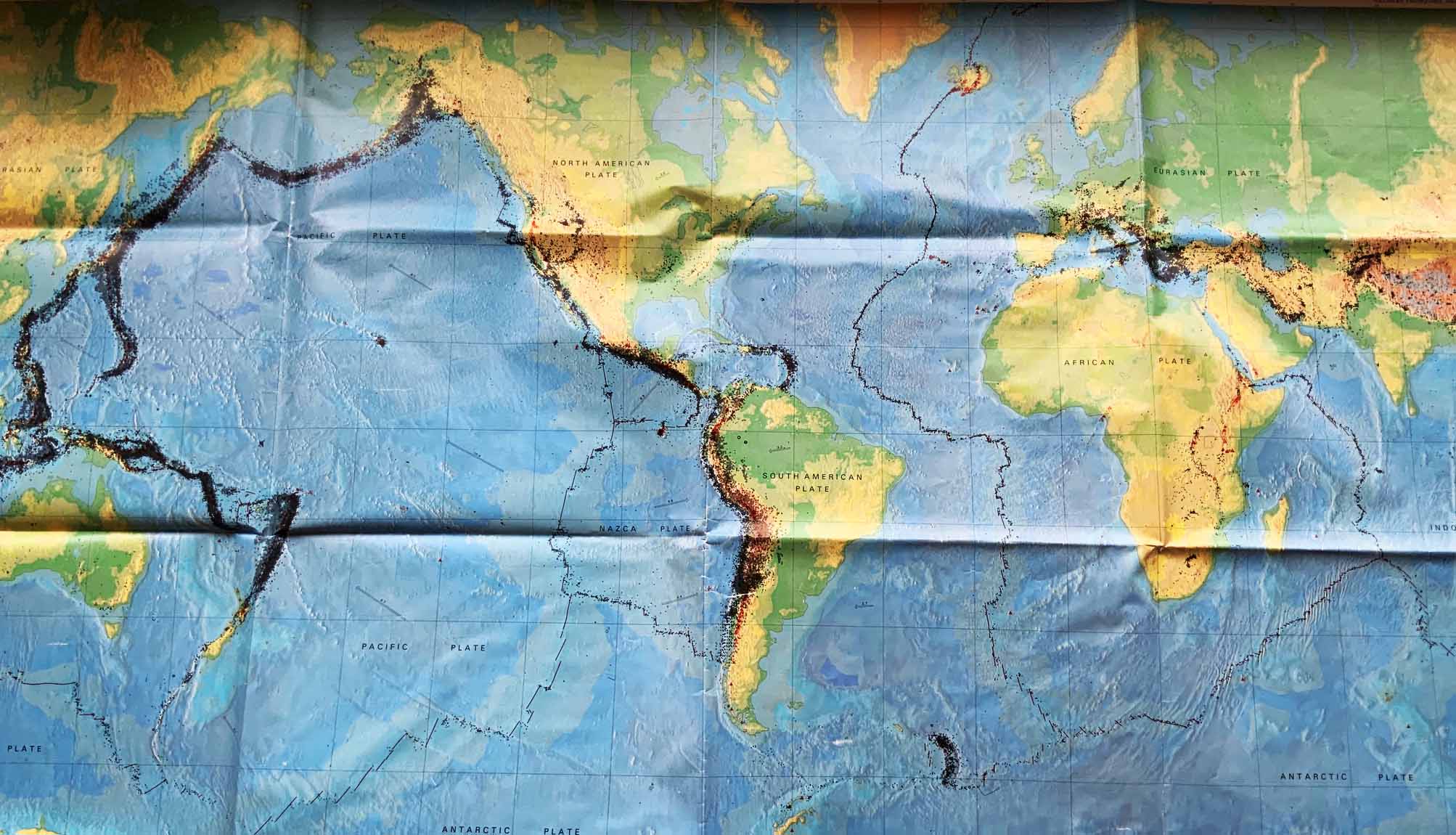
As of these huge geological maps, some of them six feet wide.
I used them as decoration along the walls of former dwellings where there was wall space; not so much for their abundance of information as for their beauty.
I want to keep them, even if only in ghostly and degraded electronic form, so that I can use them sometime to illustrate a theory of mine about aesthetics.
Worth zooming in.

Layers underlying the archaeological layers of legendary and classical Greece,

Grand Canyon of the Colorado:
Earthquakes along the seams of the tectonic plates:
California

__________
This weblog maintains its right to be about astronomy or anything under the sun.
I must confess that it upsets me every time I hear of or see someone throwing away books, even if it’s just for paper recycling. I’m a regular buyer of both new and used books, and I believe that in this new digital age of AI, reading physical books is a form of cultural resistance. Sometimes I’ve seen books on the street placed on top of recycling bins, as if the previous owners were somehow acknowledging that they might be useful to someone. Surely there’s a secondhand bookstore nearby or in town willing to take a look and pay a small amount for each one, or even take them away for free to resell.
For years my principle was to buy every book I might wish to look at again. Including any I had borrowed, or encountered in an airport bookstand. For one thing, this gave me the right to pencil notes in margins. This was what led to having too many thousands.
You might have noticed my phrase about “The many books and few other items that won’t be lost to the world, only to me, continuing in existence elsewhere because someone else will take them, or has copies of them.” A bookshop owner came to our house yesterday and picked up two cartons of books. The last two times it was easier logistically. because there was a bookshop nearer, though no less agonizing.
Well done, passing on those two cartons of books. I’m imagining each book as a quantum of intellectual energy, now off on a new adventure, like an atom of carbon or oxygen released by a planetary nebula, eventually to be accreted by a protoplanet orbiting a newborn star, eventually passing through a procession of sentient living beings.
Over the past few years “little free libraries” have popped up in front of homes in San Francisco. A small weatherproof wooden cabinet with a glass door, placed at a comfortable height on a post, has a sign inviting passersby to “take a look, take a book, leave a book.” I’ve picked up a few interesting books from nearby little free libraries, and it’s been easy to leave books I’m not going to read again, or novels I started but disliked, in nearby little free libraries. I feel good when a book I’ve left is gone a few days later.
I’ve also been borrowing books from our excellent public library, rather than buying them (although a couple have been so good I’ve had to buy my own copy, and a friend unwittingly gave me a book I had just borrowed from the library but hadn’t started reading yet).
Wonderful extension of the cluster of metaphors!
Beautiful illustrations.
Ultimately, everyone/everything downsizes.
Len Wallick speaks for me.
John (in Ludlow)
John moved out of a castle, so he had to downsize!
About 2/3 or 3/4 of the stuff in my apartment is dead weight. I get overwhelmed just thinking about getting rid of what I don’t need. But I have gotten a lot better at not acquiring more stuff.
My interest in astronomy led to an interest in meteorology, at first simply to predict whether I should bother traveling to a star party on Saturday night, then increasingly purely for the beautiful complexity of our amazing life-giving onion skin of an atmosphere. Similarly, once I realized that Earth is a planet, geology became fascinating.
Beautiful! But I am also downsizing!
Guy: When you describe the ordeal of downsizing, my empathy was so overwhelming as to take my breath away (and bring a tear or two to my aging eyes). Wise people have advised me to release attachment. i know they are right. Yet even the wisest cannot tell me how to separate myself from The Pain with anywhere near the same efficacy. My old heart goes out to you. Thank you for allowing me to feel my feet in another man’s shoes. It helps. You are among The Best, and duly appreciated for that distinction. Sincerely, Len Wallick
Downsizing is like the proverbial curate’s egg. Parts of its results are excellent.
where do you obtain these maps..
I’ve forgotten how I got them. Some may have been in the Map Shop in Greenville. More likely I saw them mentioned or advertized. Googling “geological map of Africa” would bring plenty answers.
These are just beautiful! Would it be possible to buy one or two? Maybe it would be a hassle to mail them?
I’d be glad to send them all in one package, for the cost of shipping only; the difficulty is that the method and cost of shipping are unknown. (In contrast to my former situation in the US, with a shipping office and materials.)