| A general guide to astronomy; some say it should be called the Astronomical Treasury. Road-atlas size (11 by 15 inches). Begins with an “Overview of Astronomy”and pictures that almost force you to understand coordinate systems and orientation in space.
This book is sold out, for the 21st time. First published 1979; printed 21 times; 2nd edition 2010, with major illustrations remade, and many added features. 2010 edition: 11 x 15 in., 73 pages, illustrations. ISBN 978-0-934546-60-7. New edition will be approximately 107 pages.
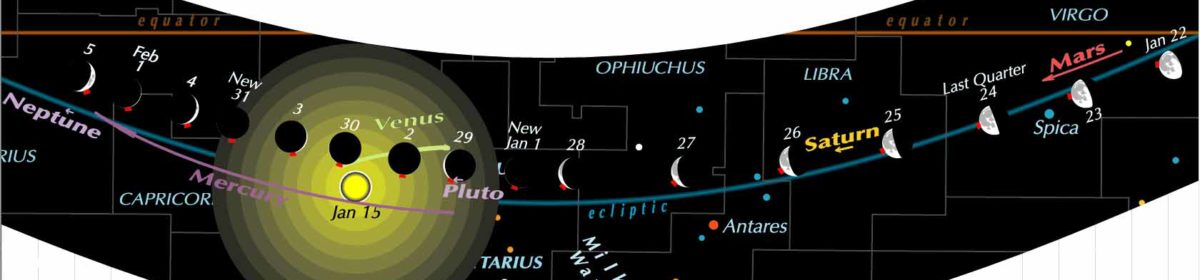
A strand running through the book is the series of 30 ten-inch-diameter diagrams showing expanding spheres of space, from the Moon’s orbit and the domains of planets and comets out through the nearest stars, the brightest stars, the neighboring regions of our Milky Way galaxy, the whole galaxy, the Local Group of galaxies, the Virgo Supercluster, the domain of the quasars, and on to the eerie limit of the universe. Among many other features are a map and catalogue of star names with their derivations; the seasons (including their linking with traditional dates such as Beltane, Hallowe’en, St. Lucy’s Day); the world’s calendars; precession and its many consequences; “Moonlight”and “Earthlight”and “Moon as Signpost”; comparative distances; a comprehensive Hertzsprung-Russell Diagram (the graph that relates all the kinds of star by color and brightness); and pages on constellations, meteor showers, double stars, variable stars. . . “The author has an unusual knack for thinking in three dimensions. It is one of the most inspired non-textbook introductions to the cosmos that have ever appeared.” —Sky & Telescope “A gold mine of information. A large variety of topics is covered and made clear with unique illustrations” —Baltimore Astronomical Society “In careful projection we view the place in which we live on the grand scale . . . The three dimensions are vivid; it is not a page we are inspecting but a spatial volume . . . an atlas of the glowing furniture of space . . . The text is excellent, full and clear, with almost no formal mathematics . . . The tough geometry is here and there allayed by a poet’s image . . . The entire work is a tour de force, the product of understanding and taste” —Philip Morrison in Scientific American “We get a characteristic ‘Now I see it!’ overview of how the universe fits together . . . The generous size of the pages permits far more detail to be included in the diagrams . . . Standard astronomy texts contain nothing akin to the graphics in this work” —Sky & Telescope |

Some illustrations in the new edition. Our brigjtest neighbors:

“At last the great shape shrinks into view”: the Milky Way galaxy, with its swarm of globular clusters.

Constellations are directions, mapped onto the imaginary celestial sphere:

The strangeness of the limiting disance of our expanding universe, toward which the most distant objects, the quasars, are receing at the highest soeeds:

Color coding helps to clarify the four planes that astronomy often has to talk about. Green is “a” horizon; it tilts differently according to where you are on Earth.

Sensing how the starry sky rolls around you, from east to west:


Sizes:

Part of the zodiac:

Explaining precessaoon, the slow difference made by the changing of Earth’s spinaxis:

Great eclipses ahead:
