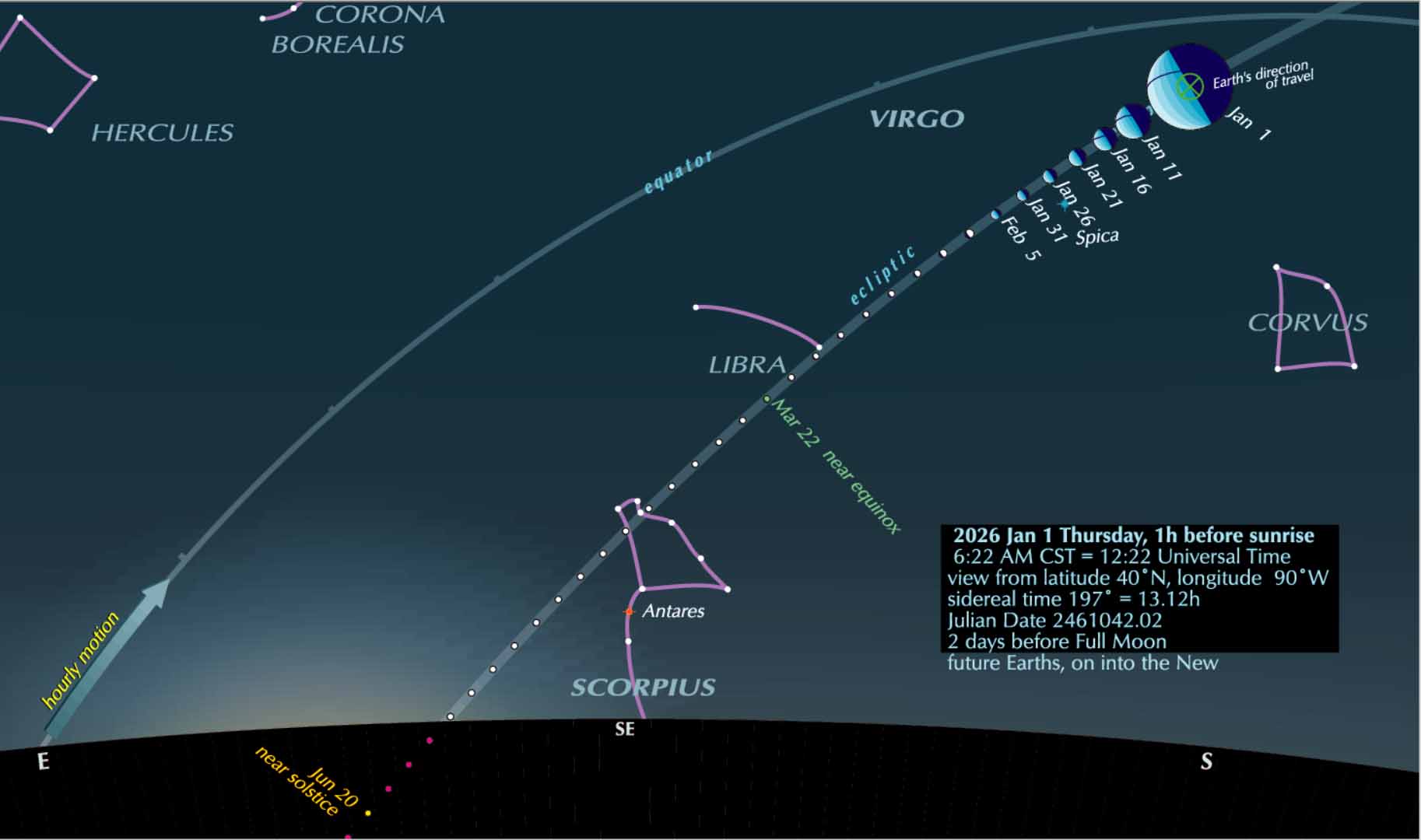
You are standing on our planet, gazing forward and imagining it at places where it will be in the future.
See the end note about enlarging illustrations.
First, Earth where it will be one hour from now. That Earth has traveled a distance of only about 8 times its own width, so it looks quite large. If we were to draw it at even nearer times, it would block out most of the picture.
Then, at a series of positions at intervals of 5 days ahead along its orbital path (the ecliptic), on into the spring and summer of the year.
All but the few nearest Earths are so distant that they have to be greatly exaggerated in size, otherwise they would be specks.
The idea for this kind of diagram sprang from a suggestion by Daniel Cummings in 2018. I showed “past Earths” and “future Earths” as we looked back into that year and forward into 2019.
Refurbishing the program was not easy. The sky scene is for January 1 so that it could be compared with the 2019 one. Better if I could have had it ready by January 1, but better late than never. The principle is the same. If you go out and look tomorrow morning, almost the whole Scorpion will be above the horizon.
The theme of “Future Earths” readily evokes extensions.
__________
This weblog maintains its right to be about astronomy or anything under the sun.
ILLUSTRATIONS in these posts are made with precision but have to be inserted in another format. You may be able to enlarge them on your monitor.
One way: right-click, and choose ”View image” or ”Open image in new tab”, then enlarge. Or choose ”Copy image”, then put it on your desktop, then open it. On an iPad or phone, use the finger gesture that enlarges (spreading with two fingers, or tapping and dragging with three fingers). Other methods have been suggested, such as dragging the image to the desktop and opening it in other ways.
I enjoy looking back at the waxing quarter Moon, and ahead toward the waning quarter. If I’m doing the math right (never a sure bet!), about three and a half hours ago the Earth was back where the waxing quarter Moon is now, or in three and a half hours we will catch up to where the waning quarter Moon is now. This is based on the Earth’s average orbital velocity and the Moon’s average distance from Earth, both of which vary quite a bit, because nothing is perfect, or simple. And the inclination of the Moon’s orbit means the Earth is exactly lined up with the Moon only when the Moon is crossing the ecliptic, usually the Moon is a few degrees north or south of Earth’s direction of travel. But still, it’s pleasant to imagine us all flying along.
Yes, this is the upshot of the “Moon as Signost” chapter of the Astronomical Companion.