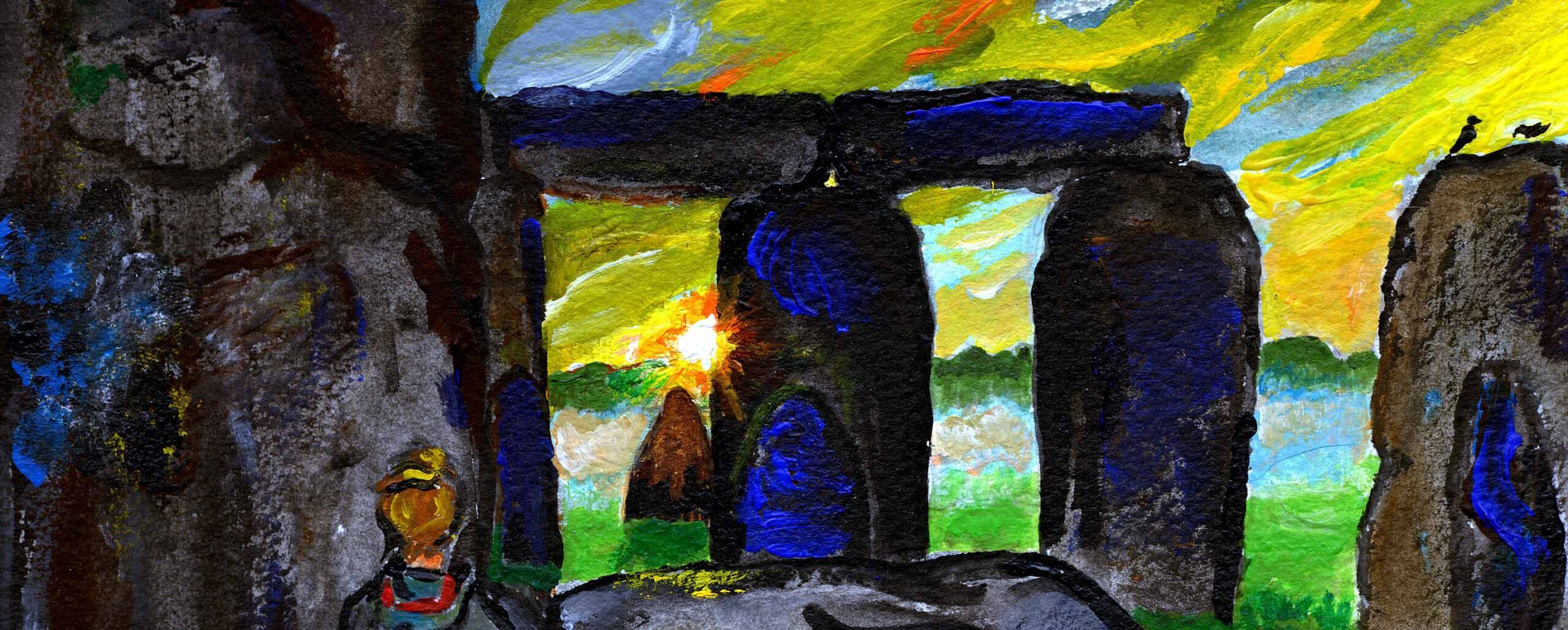
We have to be careful about calling it the spring equinox, since it’s autumn for the southern hemisphere. Yet it exudes newness, freshness, and in ancient times was associated with the start of the calendar year.
The equinox arrives on Friday March 20 at 14:45 by Universal Time.
Gazing at the western sky, you can use the imaginary lines of the ecliptic and the celestial equator to imagine the point where they cross: where the Sun (some hours after the time of the picture for this American location) will cross the equator into the sky’s northern hemisphere.

See the end note about enlarging illustrations. Arrows through the moving bodies show their movement (against the starry background) from 2 days earlier to 2 days later. The Moon is exaggerated 4 times in size.
Of the two abstract lines, the celestial equator is easier to “see” in the sense that it stays still; it slopes at a constant angle from the west point on your horizon. “Seeing” the ecliptic, the road of the Sun, is helped by the other bodies that almost follow it. Especially Venus, and the crescent Moon, which you’d be very lucky to glimpse this evening and may find more easily when it’s a day older.
Spring! It has so many meanings. The season of renewal. The leap of the body. The coiled device that stores energy. In chess, the knight, who is on horseback and makes crooked leaps over other pieces, is Springer in German. And, most refreshing, the spring is where water gushes from the ground and starts a river.
To illustrate my essay about the Pointstart, the source of the universe, I thought I could find some sketch I made of a spring. If I did, I can’t find it, so here, and of course bteter, is Ingres, “La Source.”

__________
This weblog maintains its right to be about astronomy or anything under the sun.
ILLUSTRATIONS in these posts are made with precision but have to be inserted in another format. You may be able to enlarge them on your monitor.
One way: right-click, and choose ”View image” or ”Open image in new tab”, then enlarge. Or choose ”Copy image”, then put it on your desktop, then open it. On an iPad or phone, use the finger gesture that enlarges (spreading with two fingers, or tapping and dragging with three fingers). Other methods have been suggested, such as dragging the image to the desktop and opening it in other ways.
Sometimes I make improvements or corrections to a post after publishing it. If you click on the title, rather than on ‘Read more’, I think you are sure to see the latest version. Or, if you click ‘Refresh’ or press function key 5, you’ll see the version change to the latest.