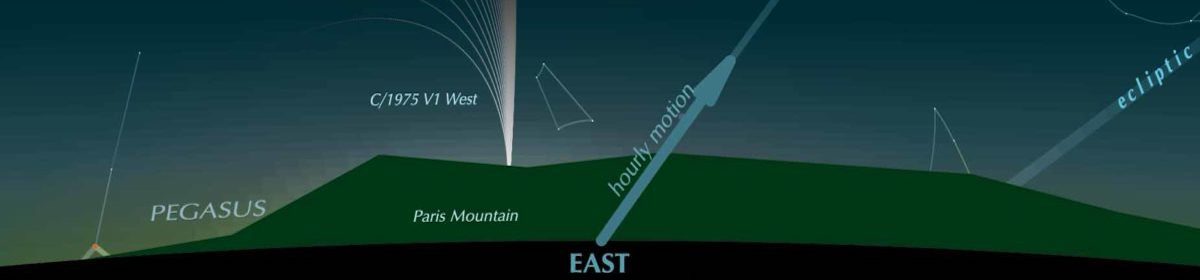
This was the sky at Philadelphia on July 4, 1776, when the Continental Congress adopted the Declaration of Independence.

Independence. There is another large cluster of related or overlapping topics:
Folk poetry and folk songs. Some are genuinely “folk,” anonymous products of a population; others are “folk” in style.
Traditional narratives in prose or verse passed down orally through generations. Some preserve the genealogies of tribes, as in early books of the Hebrew Bible, “Noah begat Shem, Ham, and Japheth”; the lists of Egyptian pharaohs recoded by Manetho; tribal genealogies collected by anthropologists.
Epics, and cycles of epics such as the Troy cycle and the Thebes cycle.
Improvised poetry.
Speaking in tongues.
Outbursts of eloquent language that incite action. Mark Antony’s speech that turned the Roman mob against the assassins of the dictator Caesar. The chapter of the Qur’an beginning Igra (“Recite!”) that was pronounced by Muhammad on returning from a contemplative retreat in the desert, a short utterance in rhyming prose that inspired his first followers. The poem that Rudagi pronounced, at the request of campaign-weary soldiers, to persuade the Iranian king to turn homeward: Buu-ye juu-ye Muuliyaan aayad hamii, “The scent of the brook of Mulian comes all at once…” The king felt such immediate nostalgia for his capital city that he leaped onto his horse without even pulling his boots on.
Poems produced on demand, such as by a poet laureate.
Town criers.
Buskers.
Stand-up comedians.
Painters who set up their easels in public and daub while bystanders look on.
Law-court artists, employed to draw, with enviable skill, pictures of scenes in court
Street performers, such as jugglers on stilts, trick cyclists, break-dancers, human statues.
What is shared by some of these is a kind of daring, a confidence to risk going out there in public and giving it a try.
I’m interested partly because of my own tendency, when allowing myself a pause before making a remark or reply, to make it in rhythmic form:
“It’s Monday, so to Monmouth we will go.”
And because, starting in school, I drew pastel portraits of people on request.
And because of the “Homeric question,” the debate that has run since antiquity as to how epics such as the Iliad and Odyssey were formed.
Was there ever the individual called Homer to whom the poems were attributed? The word, homêros, means “hostage.”
Were there poems of various kinds that were amalgamated to form the epic or became embedded in it? Performances by traveling rhapsodes in the courts of Greece’s city-states, recounting the exploits of the heroes from whom the local ruler claimed descent: such as the passage called the aristeia of Diomedes, a chieftain of Argos. And the extended similes, “As when the snow flakes fall…,” that could have been chants or hymns about the seasons and the harvest.
Were the Homeridae, “children of Homer,” his descents, or a hereditary caste with the function of knowing and reciting the poems?
Was there a single Homer in the sense of a poet of genius who smoothed the epic mass into its final form.
Whatever the process, it went on in prehistory for perhaps four or five centuries, before the epics were written down. So we have to picture bards standing up and spouting verse, either impromptu or from memory.
And that verse is in lines of the ponderous and elaborate meter called dactylic hexameter: six “feet,” with a prescribed mixture of long and short syllables. Not stressed and unstressed syllables, as in English, which would be much easier; long and short are defined quantitatively, by vowel length and consonant position.
How could a stand-up poet do it?
One tactic is stock phrases that can be kept in the nearby memory and plugged into the line, and again into another line when needed.
When in the Iliad the high king of the Greek confederation is mentioned, he is anax andrôn Agamemnôn (“Agamemnon king of men”), because those syllables fit handily into the latter half of a hexameter: di DUM DUM DUM di di DUM DUM.
Similarly his brother, aggrieved husband of Helen, is regularly boên agathos Menelaos (“Menelaus good at the war-cry”). And the Trojan hero is korythaiolos Hektôr (“Hector of the shining helm”). There are other stock phrases, such as for the beginning of speeches.
There has been increased interest in the stock-phrase device since it was shown to have parallels in other cultures, by Milman Parry and Albert Bates Lord, pioneer scholars of oral poetry, who collected recordings of Bosnian-Croatian-Serbian songs, some of them hours long.

The walkways along the Thames south bank, from the London Eye to the Borough Market, are thronged with sightseers, so there are buskers and bands and other performers. Every time we passed, near our door and in front of the Globe theatre, this “POET FOR HIRE, PAY WHAT YOU LIKE,” I have wanted to find out how he does it.
At last on July 4 we stopped and hired him, so as to be able to talk with him.
He asks for a theme. I said “It’s my birthday and it’s also America’s birthday.” He began typing at speed, and after filling a sheet of paper he dropped another into his machine, and then a third, explaining that this was a “large” theme.
His name is Luke Erasmus Davis and there is a website Lukeerasmus.com, which says that he is “co-founder of Word Trade publishing,” though searching for that brings up only the World Trade Organization.
His amount of effort deserved, I felt, a more generous “pay what you like” than the bill we had, and Tilly dashed back to our apartment for another one. I would be curious to find out what kind of one-page poem the independent poet produces when a family with a child gives a theme such as “popcorn” or “my dolly” or “happiness” or pays a penny. And whether he gave himself the middle name Erasmus, and what that implies about his philosophy.
His prepared sheets of paper are squares of only six inches, colored with orange and pale purple. His typewriter makes tiny letters, maybe about three-point size. It took me two grinding days to decipher the three sheets, enlarging with scanner.

He had seized on the theme – a person and a nation with one birthday – and given them voice as one “I.” That rapid imagining must be the key to how this spontaneous poet could do it.
Rushing into the process, he made very few typos (he didn’t know the “i before e except after c” rule) and xxx-out corrections. It was somewhat uncertain what indentions or stanza-breaks he intended.
It was too much to expect that the poem would have rhyme or meter. I leave it to you to judge whether it fits into your definition of poetry, or makes use of what might be stock phrases.
I remember it of course; the Mayflower afloat upon the
Thames. I knew where it was going and I had the
opportunity. I’d always been a boy to sieze the main
chance. I hid under the tarpaulin of the lifeboats
and endured that rough passage
caught rats, drank rainwater and arrived in a strange
paradise, a continent which I refuse to beleive
had existed until we dreamed it in the Elizabethan age.
Some say John Dee had conjured it up
in angel-trysts .
I don’t know if that is true, but dreamed it
was that vast XX land of mountains and prairiXes
and glacier, desert and mesa
I worked the tobacco fields of Virginia for a while
and watched time passing, watched a rude
settlement become a city
full of settlers we had some rough winters
and wouldn’t have made it were it not for the help
of the natives. Roasted turkey in earth-pits
and gnawed bark, ate berries
A few years have passed since then
I loitered a while in New Orleans
in the swamps where the gators yawned
heard jazz escape haunted pianos#
I was in New York while the skyscrapers went up
worked the construction crews, tip-toed across iron
girders, saw the land stretched out below
it was just a kind of confidence trick
the ships came in, disgorged immigrants
street gangs brawled in the slums fortunes were made
in the rackets. I couldn’t help but be impressed
I watched baseball games, ate peanuts
I remember it all as if it were yesterday
250 years since the apron strings were cut
and that little fraternal squabble.
Well it’s my birthday too.
I’ve seen some things from my eyrie beside the Thames
Mayflowers, and seals, and cormorants
cruciform, perched upon the buoys
waiting for their dark feathers to dry
I’ve seen some things
as the city swirled around me
and history hardened!
__________
This weblog maintains its right to be about astronomy or anything under the sun.
ILLUSTRATIONS in these posts are made with precision but have to be inserted in another format. You may be able to enlarge them on your monitor.
One way: right-click, and choose ”View image” or ”Open image in new tab”, then enlarge. Or choose ”Copy image”, then put it on your desktop, then open it. On an iPad or phone, use the finger gesture that enlarges (spreading with two fingers, or tapping and dragging with three fingers). Other methods have been suggested, such as dragging the image to the desktop and opening it in other ways.
Sometimes I make improvements or corrections to a post after publishing it. If you click on the title, rather than on ‘Read more’, I think you are sure to see the latest version. Or, if you click ‘Refresh’ or press function key 5, you’ll see the version change to the latest.
That is a remarkably inventive impromptu poem! Luke Erasmus Davis has a real gift.
When a reporter asked Woody Guthrie to define folk music he said, “It’s all folk music. Folks make music. I never heard a mule sing a song.” (That’s my recollected paraphrase, I’m too lazy to search for the exact quote.)
Standard typewriter fonts are 10 or 12 point. 3 point type would be inscrutable. I wonder if that typewriter was invented for the small print in contracts.
I’ll measure the point size sometime.
Never head a mule sing?
From “John Galpin’s Ride”:
“Ah, luckless speech, and bootless boast!
For which he paid full dear;
For, while he spake, a braying ass
Did sing most loud and clear”
Aside from the time required to type, he seems to create the poetry almost as fast as ChatGPT LOL
Good point. It would be instructive to compare a poem improvized by the human poet with a poem on the same theme requested from an AI bot. I would expect some discernible unpredictability in the human and predictability in the artificial.
That’s a great impromptu poem. Bob Dylan said a good artist changes your emotions.
I didn’t know you could catch a rat. I assume the purpose for catching the rat is for food. YUK!
Happy birthday to you, and many more!
Stolatz! (Polish for 100 years of merriment)