You – if you are in Canada, the northeastern US, Europe – will be in the partial eclipse.
The vast area that partial shadow covers is shown in the space view of Earth on page 103 of Astronomical Calendar 2026.
Though you may not be among those lucky to be in the narrow path of total eclipse, in Iceland, Spain, and a corner of Portugal, there will be excitement. People will notice daylight becoming dimmer and strange – oily – and will be tempted to look at the Sun for the cause. You, with your knowledge, will want to try to see whether that bite has appeared in the outline of the Sun. The bite that means there really is an eighty-billion-billion-ton planet up there in the blue sky and it has begun to sail between us and the Sun.
PLEASE:
Read this, the Astronomical Calendar box on Eye Safety:
__________________________________________________
DO NOT LOOK DIRECTLY TOWARD THE SUN, except when it is totally eclipsed. Some safe ways during partial eclipse are:
– Projected image through a pinhole onto a sheet of something white and fairly stiff.
– Reflected image from a small flat mirror onto a fairly distant white surface (fuzzier than the projected image but easier for a larger number of people to see).
– Looking through No. 14 welder’s glass (or No. 12 if the Sun is dim).
– Eclipse-viewing spectacles if they are from a provider you know you can trust.
Less safe: projected image through a telescope, monocular, or binocular.
Do NOT use smoked glass, exposed film, crossed polarizing filters, colored water. They may seem to dim the Sun, but infrared rays get through.
Do NOT look through a telescope unless you really know what you are doing. Any filter should be over the front of the telescope, NOT covering the eyepiece.
When the Sun is dim (low or through cloud) still take only BRIEF naked-eye looks. Retinal damage can happen without hurting.
There is nothing dangerous about sunlight during total eclipse. It’s just that we normally have an instinct not to look at the Sun; during an eclipse we are interested in doing so. During totality, it’s safe (and gorgeous) to look!
At every eclipse thousands of people in the path needlessly miss the experience, while others suffer eye-damage. THERE IS NO NEED TO DO EITHER!
__________________________________________________
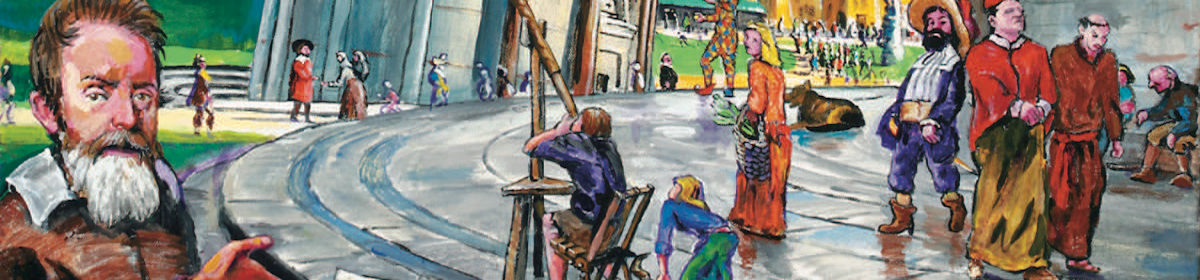
You may not have time to acquire No. 14 welder’s glass. Pinhole projection is easy with a little preparation. Here are children doing it in the cover picture of Astronomical Calendar 2019.

You can do it simply by hanging up a white sheet, or propping up something flat and white, perpendicular to the sunlight. Then from time to time hold something with a small hole in it, and maneuver it until it focuses the Sun on that white surface.
Hi Guy,
Your mention of pinhole techniques for viewing Solar eclipse partial phases reminds me of two variations of the phenomena that I rarely see referenced:
I don’t know if this always works, but standing in or near the shadow of a deciduous tree that allows multiple bits of sunlight to scatter through its leaves will display correspondingly multiple (poorly formed) images of the Moon-bitten Sun. The bits of sunlight are functioning as crude pinholes. (This got me wondering why we can’t always see (crude) images of the Sun when standing under a tree. The answer I came up with is that we actually are seeing the pinhole effect in that the bits of sunlight we see are rounder than they would be if their shape were defined solely by the crisp outlines of the tree’s leaves.)
The second phenomenon: Cross the outstretched fingers of your two hands at right angles to each other forming a matrix consisting of several crude “pinholes”. Hold that matrix up perpendicular to the incoming sunlight such that the resulting images fall on something light in color to function as a screen. Try varying the distance between your hands and the screen, etc. If things work out, you should see several (crude) images of the Moon-bitten Sun.
With all best wishes,
— James King, Farmington Connecticut
The phenomenon of multiple pinhole-like images on the ground under tree foliage is described in The Under-Standing of Eclipses, in a section what to notice during the partial stages.
I’m counting down the days until Saturday 22 July 2028, when there’ll be a total solar eclipse visible from Sydney. The centre of the path of totality runs straight through the middle of the city, about 2 km from my house.